I thought I'd write a post to let any readers out there that I'll be posting a bit less over the summer. On June 1st I'll be at a 5-day district training for Language Arts that incorporates literacy, writing and Netbooks all togethe. Near the end of June I'll be attending TIE (Technology in Education) at Copper Mountain Resort in Colorado.
I may have some insights that I will blog about here during the summer months, but mostly I'll be trying to ride my new Giant OCR3 road bike or my mountain bike in the mountains!
Thursday, May 21, 2009


Friday, May 15, 2009
Web-olution --> Wolfram Alpha

Get ready to be stunned! Wolfram Alpha will be brought online later today: May 15th, 2009.
Please watch this 13 minute introduction of Wolfram Alpha in action and you'll get a glimpse of a different way we will be using the web to learn and question. Could this be a research tool, YES? I can't wait to start using it. How would you cite it? One thought and concern I'm having about the information it returns is that it might be different over time if you are researching something that's not changing.
With tools like Wolfram Alpha, Wikipedia, Google, and other search engines available what are the essential tools you need to be able to learn from them? If these are in your toolkit are you ready to use them with these essential skills?
- Good spelling ability,(does that even matter anymore?)
- ability to come up with essential questions,
- a desire to learn,
- thirst for knowledge...
Some background - I remember back in the 1980's a very cool math program called Mathematica. It was available on the Apple Macintosh (maybe other platforms too) and it could do so many mind-blowing things graphically to represent data. I only played with it a small bit on a friend's computer, but I was impressed. The author of that program was none other than Stephen Wolfram.
I titled this post "web-olution" because I thought it captured the BIG STEP that Stephen Wolfram has taken with his project Wolfram Alpha. It's using the information on the web in a way that is quite evolutionary; thus, webolution! (I considered wevolution, but it sounds too much like Elmer Fudd - hehehehe).
Tuesday, May 5, 2009
MAPS Reports Reveal?
I'll give this post another title: "Summer Braindeath"
Each spring and fall our students take the MAP test. The MAP test is a computer-based testing system developed by the non-profit NWEA. MAPS stands for Measures of Academic Progress. It is a series of state-aligned computerized adaptive tests that accurately reflect the instructional level of each student and measures growth over time.
It's actually a pretty cool system in that it increases the level of difficulty (grade-level) of questions just to the point where students are able no longer able to correctly answer questions. Using this adaptive approach towards leveling off the questions the program determines the actual grade-level that a student is currently learning.
We completed our school-wide MAP testing for the spring and I was able to view some reports that our Media Specialist, Carol, generated. The particular report I looked at was for reading and it revealed something that is obvious to most of us, but it reinforces something that is good to consider as we head towards our out-of-school summertime... Our students at Euclid showed excellent growth in reading from fall to spring each year, but the progress they make during the school year is lost during the summer months. It's almost like starting over with kids when they return to school. Sure the students are one year older so they should be challenged with harder material than in the spring - I get that, but the number of kids that are considered advanced and/or proficient falls off each year after summer break.

I have a son with autism. He attends a year-round school. For him it is paramount that he receive a steady and uninterrupted stream of instruction year-round. His rate of learning is consistent, but slow. I have to think that our regular education students (and all students) would be better served by a year-round school - if one is to consider the rate of learning only. But of course many people before me have suggested this approach. I'll just start rambling and ranting if I continue with this point, so I'll leave you all with this urgent suggestion and the lesson learned from the MAP test.
 Make sure you and your kids are engaged in some kind of reading over the summer. Read a book, go to the library, read magazines, read a newspaper (remember them?), read to your kids, do anything to try to stave off what happens each summer with the gains they made in the past year. The lesson here is that each of us is responsible for our own learning. If we invest some time in the summer months (when it's not "REQUIRED") reading we become active learners. Our minds become engaged in the process and we ourselves start to take responsibility for our own learning. Isn't that what it's all about anyway?

Each spring and fall our students take the MAP test. The MAP test is a computer-based testing system developed by the non-profit NWEA. MAPS stands for Measures of Academic Progress. It is a series of state-aligned computerized adaptive tests that accurately reflect the instructional level of each student and measures growth over time.
It's actually a pretty cool system in that it increases the level of difficulty (grade-level) of questions just to the point where students are able no longer able to correctly answer questions. Using this adaptive approach towards leveling off the questions the program determines the actual grade-level that a student is currently learning.
We completed our school-wide MAP testing for the spring and I was able to view some reports that our Media Specialist, Carol, generated. The particular report I looked at was for reading and it revealed something that is obvious to most of us, but it reinforces something that is good to consider as we head towards our out-of-school summertime... Our students at Euclid showed excellent growth in reading from fall to spring each year, but the progress they make during the school year is lost during the summer months. It's almost like starting over with kids when they return to school. Sure the students are one year older so they should be challenged with harder material than in the spring - I get that, but the number of kids that are considered advanced and/or proficient falls off each year after summer break.

I have a son with autism. He attends a year-round school. For him it is paramount that he receive a steady and uninterrupted stream of instruction year-round. His rate of learning is consistent, but slow. I have to think that our regular education students (and all students) would be better served by a year-round school - if one is to consider the rate of learning only. But of course many people before me have suggested this approach. I'll just start rambling and ranting if I continue with this point, so I'll leave you all with this urgent suggestion and the lesson learned from the MAP test.
 Make sure you and your kids are engaged in some kind of reading over the summer. Read a book, go to the library, read magazines, read a newspaper (remember them?), read to your kids, do anything to try to stave off what happens each summer with the gains they made in the past year. The lesson here is that each of us is responsible for our own learning. If we invest some time in the summer months (when it's not "REQUIRED") reading we become active learners. Our minds become engaged in the process and we ourselves start to take responsibility for our own learning. Isn't that what it's all about anyway?
Tuesday, April 28, 2009
Elementary Laptop Visit
It's been several weeks since our visit to three elementary schools. The purpose of the visit was to get a first-hand glimpse of the pilot schools where 5th grade students were given netbooks to enhance their language arts skills.
Well, there's a lot more to it than that. It's not as if the netbooks were just plopped down without guidance, support and training for the staff and their students. I'll not dwell on that part of the task, but sufficed to say that the students and teachers are showing proficiency and expertise. There seems to be a general enthusiasm for the tools and the expanded emphasis on writing for these students.
We were able to chat with students at each school and observe their writing. It was a fantastic opportunity for our 6th grade LA teachers to get an advance look at the project AND the students who will be attending our school in the fall. I found the trip to be rewarding for many reasons. It got us talking together as a team about the netbook project, it gave us an opportunity to see it in action, and it helped our teachers to bond with other teachers who have been doing this and paving the way. In a way it showed our teachers, who are already doing a lot with their smartboards, other ways in which LPS is making 21st Century Learning a possibility for all students.
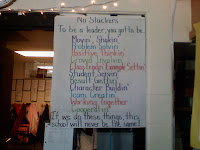
Here's a few pics taken during our visit. If you click on them, they will get bigger.


Well, there's a lot more to it than that. It's not as if the netbooks were just plopped down without guidance, support and training for the staff and their students. I'll not dwell on that part of the task, but sufficed to say that the students and teachers are showing proficiency and expertise. There seems to be a general enthusiasm for the tools and the expanded emphasis on writing for these students.
We were able to chat with students at each school and observe their writing. It was a fantastic opportunity for our 6th grade LA teachers to get an advance look at the project AND the students who will be attending our school in the fall. I found the trip to be rewarding for many reasons. It got us talking together as a team about the netbook project, it gave us an opportunity to see it in action, and it helped our teachers to bond with other teachers who have been doing this and paving the way. In a way it showed our teachers, who are already doing a lot with their smartboards, other ways in which LPS is making 21st Century Learning a possibility for all students.
Here's a few pics taken during our visit. If you click on them, they will get bigger.


Thursday, April 23, 2009
Vision
On my bike ride yesterday I stopped along the Platte River at a bench and saw the following sign on a rock. I snapped a photo with my cell phone, emailed it to me work account and went on my way. This rock seemed to be telling me something with the sign and I'm glad I saw it when I did. The message on the rock is: "Vision without action is merely a dream".

I believe the message on the rock was meant as a follow-on message to my prior post on this blog about our Mission at EMS. As our plans for the fall solidify we definitely have a mission and a vision for where we want to be in years that follow.
Have you ever had something cosmic like this happen? A coincidence that seems like it's more than just happenstance. That's how it felt when I leaned back on the bench and saw this rock.
Finally, I'll ask the obvious question: What is your vision for education in this 21st Century?

I believe the message on the rock was meant as a follow-on message to my prior post on this blog about our Mission at EMS. As our plans for the fall solidify we definitely have a mission and a vision for where we want to be in years that follow.
Have you ever had something cosmic like this happen? A coincidence that seems like it's more than just happenstance. That's how it felt when I leaned back on the bench and saw this rock.
Finally, I'll ask the obvious question: What is your vision for education in this 21st Century?
Tuesday, April 21, 2009
The Mission - Future is Now
This post is all about the mission defined by our district, Littleton Public Schools, and how technology supports and helps make that mission possible. I have had a fair amount of experience with mission and vision statements. I'm a founder for a successful web-based start-up, I've led teams in quality-driven corporations where understanding the corporate mission is vital to success, and I've held numerous positions as 'leader' throughout my life.
As an employee of LPS and a proud parent of students here I believe in our Mission - stated below.
The District Mission is defined as:
As an employee of LPS and a proud parent of students here I believe in our Mission - stated below.
The District Mission is defined as:
To educate all students for the future by challenging every individual to
continuously learn, achieve, and act with purpose and compassion.
LPS' Information Technology Department's Mission is defined as:
continuously learn, achieve, and act with purpose and compassion.
LPS' Information Technology Department's Mission is defined as:
To define the 21st Century Learning Space, to assure Universal Access to that space, for all learners to master new frontiers in communications, information and literacy.
and IT's vision is:
I believe these missions and visions are in alignment. They are all forward-looking. They have great potential for everyone involved and "on board" with our Mission. These phrases aren't just words, they are a call to action to all staff and students. We are in a time of rapid change. We are embracing that change in a positive way if we execute our mission. It is my belief that everyone needs to be part of this mission or make way for those who are. The time is now!
The three statements are all forward looking as I mentioned earlier. They all have as their end-game a focus on the future. But as we are aware the future is just out of our reach, but it's the 'carrot' that is dangling outin front of us and it moves us forward. All we have is the present to grasp and deal with. We must focus our immediate energies towards in the present. So I ask you staff and students: What are you doing today to make the Mission as success?
How does the district ensure success? Our district leaders must "walk the talk". The mission must be communicated clearly. The district leaders (at all levels) must not just say the words. They must also embrace them in their actions and they must convey a sense of urgency to everyone.
Who are the leaders in a public school district? I answer this question by stating that everyone is a leader at some level.
and IT's vision is:
LPS will support the necessary technology for world-class student learning and professional practice.
I believe these missions and visions are in alignment. They are all forward-looking. They have great potential for everyone involved and "on board" with our Mission. These phrases aren't just words, they are a call to action to all staff and students. We are in a time of rapid change. We are embracing that change in a positive way if we execute our mission. It is my belief that everyone needs to be part of this mission or make way for those who are. The time is now!
The three statements are all forward looking as I mentioned earlier. They all have as their end-game a focus on the future. But as we are aware the future is just out of our reach, but it's the 'carrot' that is dangling outin front of us and it moves us forward. All we have is the present to grasp and deal with. We must focus our immediate energies towards in the present. So I ask you staff and students: What are you doing today to make the Mission as success?
How does the district ensure success? Our district leaders must "walk the talk". The mission must be communicated clearly. The district leaders (at all levels) must not just say the words. They must also embrace them in their actions and they must convey a sense of urgency to everyone.
Who are the leaders in a public school district? I answer this question by stating that everyone is a leader at some level.
- Naturally, we have a superintendent of schools and the school board who are leaders at the highest level.
- We have building principals and the administrative staff that establish school vision and lead the school to success.
- We have teachers who lead their students every day in the classroom.
- And we have students leaders as student-body presidents, classroom leaders and squad leaders on sporting teams.
- Each student must self-lead in their learning - -they are responsible to themselves for their learning too.
Wednesday, April 15, 2009
Long Now Foundation, Time and a Book
I read the book Anathem by Neal Stephenson awhile back. It's long, very long at over 900 pages. Once I got a handle of the tweaked language he was using I found myself falling into the book and his writing style. I loved the story and concept of living in a "Mathic world" where one could devote their life to the study of math and philosophy. And I thought that would be the end of it, but then here's where fiction meets reality...
People here on Earth are actually doing and thinking about stuff like this. They have founded an organization to ponder life with long-term thinking in mind. Here's a piece of the real clock design being built in a remote area of Eastern Nevada. It is based upon the designs mentioned in the fictional world of the aforementioned book.

So I mentioned that there is an organization founded upon the principle of long-term thinking and its name is the Long Now Project. Much of what the book discusses is being thought about for this group and I think that's pretty cool. Reality meet Fiction meets Reality!
I just happen to have been interested in this artist Brian Eno for MANY years now and have followed his music, seen some of his art exhibits and enjoyed much of what he does. He has worked with U2, David Bowie and many music artists over the years. And not to my surprise he's involved in this foundation too. How weird is it when all these different pieces of one's life (some even fictional) meet together as one?
People here on Earth are actually doing and thinking about stuff like this. They have founded an organization to ponder life with long-term thinking in mind. Here's a piece of the real clock design being built in a remote area of Eastern Nevada. It is based upon the designs mentioned in the fictional world of the aforementioned book.

So I mentioned that there is an organization founded upon the principle of long-term thinking and its name is the Long Now Project. Much of what the book discusses is being thought about for this group and I think that's pretty cool. Reality meet Fiction meets Reality!

I just happen to have been interested in this artist Brian Eno for MANY years now and have followed his music, seen some of his art exhibits
 and enjoyed much of what he does. He has worked with U2, David Bowie and many music artists over the years. And not to my surprise he's involved in this foundation too. How weird is it when all these different pieces of one's life (some even fictional) meet together as one?
Subscribe to:
Posts (Atom)